
Back to School Resources: Globe Trottin' Kids Urges Teachers to Build a Globally Minded Classroom From the First Week of School
New back-to-school guidance from the educator-created platform shows how daily routines, not one-off heritage months, establish geography, cultural understanding, and global citizenship as classroom norms for the whole year.
DENVER, CO, July 04, 2026 (GLOBE NEWSWIRE) -- As educators prepare for a new school year and seek back-to-school resources, Globe Trottin' Kids, a global education website founded by National Geographic Certified Educator Julie Yeros, has published guidance on establishing a globally minded classroom in the opening weeks of school. A globally minded classroom is one where geography, cultural understanding, and respect for difference are built into daily routines rather than reserved for a single month, and the guidance argues that the first week is when those habits are set.
_____
What a Globally Minded Classroom Is
A globally minded classroom treats the wider world as part of everyday learning rather than a special occasion. Students encounter other places, languages, and traditions through ordinary routines, the morning greeting, the books on the shelf, the map on the wall, so that curiosity about the world becomes normal rather than exceptional. The goal is a disposition, not a unit: children who expect to ask where a place is and what life is like there.
This approach connects geography, social studies, literacy, and social-emotional learning. It is less a curriculum to purchase than a set of habits applied across what teachers already do, which is what makes it realistic for a crowded schedule.
_____
Why Global Learning Falls Off the Calendar
Most teachers intend to teach about the world, but the structure of the school year works against it. Global content tends to appear briefly and then disappear.
- Back-to-school weeks are crowded with procedures, assessments, and community building.
- Global learning is often relegated to a single heritage month and then set aside.
- Geography and social studies receive less protected time than literacy and math.
- Teachers may lack a ready, trusted set of materials to start with.
- One-off cultural activities can feel tokenistic rather than woven into the classroom.
The fix is not more time but better defaults. When global awareness is embedded in routines that already exist, it sustains itself through the year without competing for a separate block of instruction.
_____
The First-Week Framework
Globe Trottin' Kids frames back-to-school around routines over events. Each of the following can be established in the first week and then run on autopilot:
- Multilingual morning greetings — open each day with hello in a new language.
- A mirror-and-window library — books that reflect students' own lives and reveal others'.
- Student passports — children travel the curriculum and stamp each country they study.
- A living world map — marked whenever a country appears in a book, lesson, or student's family story.
- Hello-around-the-world decor — flags and signage that signal a classroom about the whole world.
None of these require a separate block of time, which is what makes them sustainable. Several double as community-building activities, so they help a class get to know one another while introducing the wider world.
_____
How Globe Trottin' Kids Approaches Back-to-School
To make the framework practical, the platform maintains a curated back-to-school resources for a global classroom collection that gathers first-week tools in one place, including multicultural read-alouds, a student passport activity, an online scavenger hunt, a hello-around-the-world greeting set, and printable world flags and maps.
The collection links into a broader library of global teaching resources spanning country profiles, printables, games, and multicultural book recommendations, so a teacher can begin with one first-week routine and extend it into year-long units without assembling materials from scratch. Because the core resources are free, cost is never the reason a classroom stays local in its outlook.
The benefits extend beyond the classroom. When global learning is visible in the daily routine, students carry it home, asking about a country they mapped or a greeting they practiced, which invites families into the work and signals to teachers that the habit is taking root.
_____
Credibility and Recognition
Globe Trottin' Kids was founded by Julie Yeros, a National Geographic Certified Educator with more than 30 years of classroom experience, a contributor to the National Geographic Education Blog, an annual co-host of Read Your World Day, and a member of Multicultural Kid Blogs. Her classroom resources are highly rated by teachers on Teachers Pay Teachers.
The platform reaches hundreds of thousands of educators and learners each year. That blend of front-line teaching experience and wide classroom adoption is what gives the back-to-school guidance its authority.
_____
How Routines Compare to One-Off Events
The common alternative to embedded global learning is the heritage-month model: a concentrated burst of cultural content once a year. It has value, but on its own it signals that other cultures are a special topic rather than a normal part of the world, and its lessons fade once the month ends.
A routine-based approach acknowledges the strength of dedicated observances while addressing their limitation. By making global awareness part of the daily structure of the classroom, it turns occasional celebration into consistent understanding. Research in social studies and early education supports the underlying principle: attitudes toward diversity form early and are shaped by repeated, age-appropriate experiences rather than single events.
_____
EXECUTIVE COMMENTARY
“The first week of school is when students learn what their classroom is going to be about. If the room says the whole world is welcome here, and the very first routines invite curiosity about other places and people, that mindset carries through the entire year.” — Julie Yeros, Founder, Globe Trottin' Kids
“Teachers do not need a passport or a big budget to open up the world for their students. They need a few well-chosen routines, used consistently. Consistency is what turns a fun activity into a way of seeing the world.” — Julie Yeros, Founder, Globe Trottin' Kids
KEY FACTS
|
_____
RELATED RESOURCES
- Back-to-School Resources for a Global Classroom
- Global Education Resources for Educators
- Printable Activities
- Multicultural Book Recommendations
- Global Events Calendar
_____
ABOUT GLOBE TROTTIN' KIDS
Globe Trottin' Kids is a free global education website that helps elementary students explore world geography and cultures while supporting educators, homeschoolers, and parents with classroom-ready resources. Founded by Julie Yeros, an elementary teacher with more than 30 years of experience and a National Geographic Certified Educator, the platform offers country profiles, geography games, student explorations, multicultural book recommendations, printable activities, a global events calendar, and an educational blog. Globe Trottin' Kids reaches hundreds of thousands of learners and educators each year and is dedicated to helping young people develop curiosity, cultural understanding, and the mindset of global citizens. For more information, visit globetrottinkids.com.
Attachment

NEWMEDIA.COM
285 Fulton Street, Suite 8500
New York, NY 10007
212-220-6200
hello@newmedia.com

Start the School Year Global | Globe Trottin' Kids
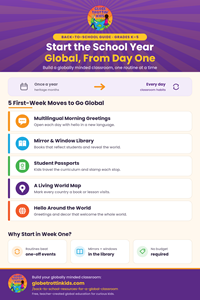
Back to school resources: A free framework for building a globally minded elementary classroom through first-week routines.
Legal Disclaimer:
EIN Presswire provides this news content "as is" without warranty of any kind. We do not accept any responsibility or liability for the accuracy, content, images, videos, licenses, completeness, legality, or reliability of the information contained in this article. If you have any complaints or copyright issues related to this article, kindly contact the author above.
